Showing posts with label Capitalism. Show all posts

Sunday, February 7, 2016

Steinem and Albright on Young Women for Bernie: White Feminism in America


Many people, young women especially, are upset with Gloria Steinem. Rightfully so.

In an interview with Bill Maher, Steinem was asked why younger women favor Bernie Sanders over Hillary Clinton. She responded, "When you're young you're thinking, 'Where are the boys? The boys are with Bernie.' "

To which I say:


Steinem is not the first white feminist icon to shame young women for supporting Bernie Sanders. Madeleine Albright has chimed in as well, suggesting that young women are misguided. Steinem and Albright are part of a growing group of older women invoking the idea of completion, of victory, of an end to the feminist revolution. As Alan Rappeport notes in the New York Times, Clinton herself has started "reminding voters that her election would signal the end of a long road for women." 

If you listen carefully, you can hear the echos of people in the days following Michael Brown's death: We have a black president, racism is over! 

Rather than flocking to Clinton, young women are rooting for Sanders not because we want to "find boys," but because we're not foolish or privileged enough to believe that a woman in the white house will finally mean equality

The problem is an old one: mainstream feminism in America is, like all things, whitewashed. In fact, it's not just "colorblind," but impervious to class struggle as well. It's easy to think that a woman in the white house would be the End. The end to a long and difficult struggle, the end to women being deemed less than. I wish it were the case. But's it's not. A black president didn't end racism in America and a female one won't end sexism and misogyny. 

I support Sanders for a multitude of reasons. And I believe that his policies will help more kinds of women. If capitalism falls, I have no doubt that we'll see every other racist and sexist institution in this country start to crumble.

Capitalism is a massive evil that thrives off of human suffering. When a country's economic system is focused entirely on making as much profit as possible, the following things are necessary:

a low minimum wage
few regulations (workplace and environmental)
a strong, large military
militarized police

All of those things lead to these things:

mass poverty
poor schools
dangerous workplaces
environmental disasters
environmental degradation
war
dead teenagers
high prison population
unfair imprisonment

...and much more. One of the questions I ask myself when deciding who to vote for (or whether or not I should vote) is, "What does this person's policies mean for women?" It's not my only concern, but it's a big one. To be honest, Bernie Sanders isn't radical enough. But he's a vocal critic of capitalism. And an end to capitalism would have an incredible impact on the lives of women everywhere:

More choice when it comes to education and work (because right now, a lot of us have to really wonder if it's worth it to get in debt knowing we might spend months or years out of work - less college debt would make that choice easier)

Ability to work (higher wages mean better ability to afford daycare)

Ability to stay at home (higher wages mean a family can survive on one income)

Better healthcare

Less violence (violence against women is a problem in every class and race, but I can't help but wonder if less dire economic struggle will lead to less violent crime in areas that are currently riddled with it)

Less grieving -

Women lose their kids every day under capitalism. Capitalism doesn't see war as a last resort, it sees it as a way to make money via weapons manufacturing and exploitation of weaker countries. If we no longer see through the lens of capitalism, I think we'll see less war. For women that means a. less dead or injured female soldiers and b. less grieving mothers and wives. I am not a pacifist; I believe war is necessary in some cases. However, America starts wars left and right for economic reasons and every time we do that we make more mothers of dead children. We make more widows. Sanders isn't going to magically end all wars, but a challenge to capitalism might strike a blow to the military industrial complex and I am all for that.

War isn't the only way capitalism robs mothers of their children. Our police force has been militarized and our prisons are made to create profit. Both of these issues are problems for all of us, but especially for people of color. I've listened to black women say they're scared to have children. They're scared to have children that will be shot by police. They're scared to have children that will be shipped off to jail for smoking pot - the same offense that leaves many white children with probation. When we cease to have a system that operates with the primary purpose of making money, maybe some of the problems with our justice system will end. I don't imagine for an instant that the election of Bernie Sanders - or even a complete end to capitalism - will make racism disappear. But I do think radical economic changes would eliminate some of the more egregious symptoms of racism in our country. Maybe there will be less dead black boys. If there's even the tiniest hope of that, then you're damn straight I'm going to vote for the person I think can make it happen.

Of course, there are a million more ways that all women can benefit from the changes Bernie Sanders hopes to make. These are just the ones that weigh most heavily on my heart.

And in case you don't ask yourself how a candidate's policies will help women, there are other reasons to vote for Sanders too:

he's better on the environment
his foreign policy (or what it could be if he articulated it better) is more in line with my beliefs
he's better on immigration
he's better on racial issues

My point is that there are a thousand valid reasons any young woman might be supporting Bernie Sanders. Gloria Steinem and Madeleine Albright are betraying the very people they've claimed to fight for all these years. No, we won't go to hell for not supporting Hillary Clinton. No, we're not voting for Bernie Sanders in the hope to find our husbands. To suggest that young women are naive or that we're making decisions haphazardly is ageist and hypocritical. Bill Maher was right - if he had suggested women are voting for Sanders simply because "that's where the boys are," there'd be hell to pay. I wonder if it's almost worse, though, that women who are known the world over as feminist icons have made these comments. Don't patronize me, Gloria Steinem. I'm not supporting Sanders to impress my man crush; I'm supporting Bernie Sanders because he is, by far, the best candidate for the job.
__
Charlotte

Monday, January 11, 2016

Space Exploration Should be a Public Endeavor


I haven't been feeling well these last couple of days, so I've been spending a lot of time on Netflix. Since one of my goals for the year is to watch more documentaries, I pretty much immersed myself in Cosmos: A Spacetime Odyssey. I also made time for some Ted Talks: Space Trek, though. I've enjoyed both, but one of the Ted Talks irked me a bit. The man giving the talk, Bill Stone,* suggested that the private route is the best route for space exploration; that a business endeavor is more likely to advance in space travel and science, since there is competition. (I believe it was episode 3 on Netflix.)

Here's the thing, though. The competition might fuel discoveries and action (while the public programs move at a slower pace, because we give them no money). But when it's a private company, the motive behind that competition is often money. Profit. So as these discoveries are made - when we get to the moon again, when we build a fuel station that can help us achieve further travel - that motive (money) will manifest, probably in greed. 

I don't want space travel where money is the driving factor, the only thing that matters. Some of the private organizations pursuing the idea of space travel have already talked about hotels, about tourist flights, about mining. If private organizations lead the way into deep space, it won't be accessible to everyone. The people won't be put first. What do I see when I think of private companies taking the lead? I see projects with narrow vision. I see the buying and selling of resources that ought to be free for the public (I mean, it baffles me that water is not free on Earth). I see another playground reserved for the ultra rich (but some of us mere mortals could be shipped up there to do the work). I see public ideals being thrown away, and corporate greed taking over. This is, nearly always, the outcome of private endeavors. Corporations have already wreaked havoc across the globe; are we really going to let them ruin the galaxy for the rest of us, too? 

Don't get me wrong, great things can come from private work. I think Steve Jobs was brilliant. But the purpose of private industries is to specifically look for those things that will entertain consumers. When it comes to space travel and exploration, that's not enough. The purpose needs to be broad. It needs to look not just for what we want, but for what we don't know yet. Or what we can't even fathom yet. Much of what scientists find is stuff they weren't looking for in the first place. The benefit, other than knowledge itself, is that good things come from exploration. The amount of beneficial discoveries that are made entirely by accident is staggering... and it's less likely to happen if you're exploring through a narrow lens of "What Here Can Be Turned Into Profit?" 

Naturally, the episode immediately following was a talk from Brian Cox on the importance of public funding for science, and for what he called "curiosity-driven science." Perfect. You can view it on Netflix (it's episode 4) but you can also see/read it here. That's the difference. Curiosity-driven exploration can and will benefit the world and all of humanity. Profit-driven exploration is less likely to benefit all of us, as the nature of anything driven by profit is that there's a problematic supply-demand scheme. We need broader ideas. 

Even if there wasn't an intrinsic flaw in profit-driven anything, I don't trust corporations. I think I share that feeling with a large chunk of people. They deplete resources, treat people as disposable items, and follow a means to an end philosophy. And even if there's a benevolent rich person out there who really does want what's best for everyone... it's risky. What happens when that man dies and a conglomerate of money hungry board members take over decisions? Inevitable? Maybe not. Likely given the nature of capitalism? Yes.     

Space exploration is too big, too important for us to let fall into the hands of corrupt rich people. Greed and exploitation are natural (horrific) results of capitalism, and they have no place taking the lead on something as paramount as space exploration. 

"Pale blue dot." That's us. This is way too big to be driven by money.
(I acknowledge the fact that private companies exist. That doesn't mean they ought to be leading things of public interest. I'm not opposed to hearing about private partnerships, so long as public interest will be preserved.)

I'm not pretending I fully trust the world's governments. I certainly don't fully trust our own. (And woop - ours is basically a corporate cheerleader, all the more reason to revolt and/or implement publicly funded elections, hey.) But I do think there's a tad more accountability. And while I think it'd be ape-shit crazy to have, say, the pentagon lead it (last thing we need is an expansion of the military industrial complex...), I trust NASA's intentions. 

Stone was right that NASA and other government and public organizations aren't doing enough. But his suggestion of business ventures to get the process going is an ironic one, since the problem is that too many public dollars are given to private companies (through corporate subsidies and through contracts with weapon manufacturers). 

It seems that the proper solution is to just better fund science. Scientists - those at NASA, at universities, at centers across the world, are just as motivated as corporations. In fact I'd argue they're more driven, since the science itself is motivating them. They're passionate. Public organizations are more than capable of the job. It's not motivation or ability that public organizations lack, it's funding. Instead of fueling the privatization of space we should cut back on corporate subsidies and on defense, and maybe throw NASA another penny from every tax dollar collected.

When it comes down to it, space exploration should be a worldwide endeavor. It shouldn't be something done by a few for profit. Space travel has the potential to answer questions that people have been asking for thousands of years. It's got the potential to change history for all of humankind and for our planet. It's therefore only right that public institutions are the ones that lead the expeditions.    

Deep space travel isn't a business venture. It's an exploration by and for all of humanity. 
__
Charlotte

*Based on the talk, Stone seems like a good guy, and he's obviously very smart. I do think he's misguided on this one, though. Also I love that a man who explores caves has the last name "Stone."

Tuesday, October 27, 2015

The Right to Life and Family


This isn't a post on abortion, though I fall on the unpopular side of that debate. It's a post about how people want to have children, but can't. Or how people want to have children, but are too afraid. It's about how we, as a country, prioritize everything material and disposable over everything sacred and eternal. It's about a few of the ways we're tragically misguided. Specifically, it's about how gun violence, police brutality, and poverty are robbing people of their inherent right to life and family.
  
I've mentioned before that the idea of having kids in this country scares me because of the gun violence. I won't let the fear stop me from having kids, but it's infuriating. Parents have enough to worry about without mass shootings. I don't know if stripping everyone of their guns is the answer, but I do know that it's unacceptable to leave things as they are. People are more important than arsenals. It sickens me that there are people who refuse to just have a conversation about gun laws meanwhile lives are being taken every single day. It always hurts more when the victims are kids, but a 40 year old who is killed in a shooting is just as precious. He's someone's kid.

I guess I just have to wonder: to the people who refuse to talk about stricter gun laws, many of whom are parents - are you willing to let your kid be sacrificed? Because that's what it takes. Maybe it's not your kid today, but 10,000 kids are shot each year in the US, and many of them - about 8 a day - are killed. And that's just children. That doesn't count the 27 year old adult who is still someone's baby.

When I have kids I'm going to read stories to them, true and fictional. They'll read about Harry Potter and how he was Christlike by sacrificing his life for his friends. They'll read about Frodo and Sam accepting their seemingly inevitable death in a quest to end evil. They'll know the true stories of saints and martyrs across time who died for others, or who were killed for their beliefs. As a parent, I'll have to reconcile teaching my kids these virtues and hoping that a situation that puts them in such danger never arises.

I will not, however, willingly sacrifice my kids to the gun lobby, nor will I sacrifice other people's kids by refusing to talk about gun laws.

I believe we can all agree that we have a right to life. We also have a right to family - to create or foster life. Those are natural rights afforded to every single person. Natural! There is nothing "natural" about the right to tote a man-made weapon created solely for the purpose of inflicting harm on others. 

With every shooting, with every bogus NRA lobbying session, we're chipping away at someone's right to have a family. The world will never be completely safe, nor should it be. But there's a difference between natural danger and risk and a deathtrap. (Even I, while writing this, felt like "deathtrap" was an exaggeration, but there are bulletproof blankets and mats specifically made for schoolchildren to wear, so it's really not.)

The vast majority of my friends are still unmarried or without children. (Though some have started families.) Whenever the topic of kids comes up, someone at some point mentions the fear of it all. It's too much. Parenthood will always be scary, it will always be hard. But it shouldn't be scary for these reasons. No one should have reason to say, "I'd like to have kids but how can I? People are being killed every day and nowhere is safe. How can I have kids in a world like that?"

Bottom line: Even if we're just talking about child deaths, thousands are killed. Kids are killed in their homes because of lax storage laws. They're being shot at school. Just typing that sentence - children are being shot to death in their schools - feels wrong, and yet, we're doing nothing about it. In this country, toddlers are killed by guns more often than police officers are.

Maybe you're getting mad at me for politicizing the deaths of so many innocent people. But I'm angry at everyone who refuses to politicize it. It's a national problem and we need national solutions. It's not that I give a damn about politics, it's that I have seven little brothers and sisters; it's that one day I want to get married and have a bunch of kids and take them to football games without them getting shot.

It is about life and about families. 

Which brings us to the issue of police brutality. Because while gun violence is a threat against everyone with a pulse, black parents in this country are bearing a burden like no other. They have to worry about the same things white parents worry about and then they have to worry about things no person should have to worry about: will my child be hurt by police?

Yesterday a video went viral. It shows an officer violently throwing a black girl to the ground, hitting her, dragging her across the room. Her offense? She was being "verbally disruptive." Short of saying, "I have a weapon and am about to kill you," there was no justification for that kind of violence.

(I think I've done a good job being civil so far but I'm going to put that aside for a second. Why the fuck do we think it's okay to arrest a schoolchild for being verbally disruptive? How is that normal? Even if the cop never became brutal, there's no reason the girl should have been arrested. You misbehave in school, you go to the principal's office, not the penitentiary. But we'll talk about the school to prison pipeline, the profits of prisons, and all that jazz in another post.)

Now, I know that cops will abuse anyone, not just black people. Cops tased and strangled my handcuffed, barefoot brother (why was he getting arrested? for back-talking to a cop.). But I don't worry about them killing my brothers. Are white people ever killed by cops? Yes. But not the way black people are. (I've written about this before.) A police officer's job is dangerous, yes. Many of them are honorable, yes. But when so many of them are killing so many people (and a specific race of people, at that), we need to ask ourselves what's wrong with the institution as a whole. It's clear there's a problem, and if you deny it, you're either ignorant, defensive of your privilege, or complicit.

If you refuse to talk about police brutality in a completely honest way that acknowledges the systemic racism, you're ignoring the rights of others. Because again:

We all have a right to life. We also have a right to family - to create or foster life. Those are natural rights afforded to every single person. Natural! There is nothing "natural" about a state-created and state-sanctioned force of highly armed officers being allowed to kill whomever they feel doesn't deserve to live.

Black mothers are cradling their dead sons. Black parents are trying to teach their kids to be strong and independent, but to navigate a world that is against them. And don't try telling me this world - at least, this country - is not against them. If you saw a man throwing a teenage girl around at the mall, you'd intervene. If you saw a father slam his daughter to the ground and beat her, you'd intervene. If a teacher beat up his student for being disruptive, you'd be furious. (And I'm willing to bet that had this been a white girl, no one would be making excuses for the cop.) But we've given cops a free pass to torment black people. I say "we" because laws are largely written by and for white people. There are laws against teachers hitting their students, but we put cops in black schools and let them hit students.

I have black friends and black cousins who don't want kids for one reason only: they don't want to have kids just so they end up being killed by police or vigilantes. 

If you can't see how that's anti-life or anti-family, then you're not looking hard enough.

It's totally about politics and it's totally about racism and it's completely, totally about life and about families.

Which brings us to poverty. I'll keep this short, I just wanted to mention a few things: we've got an ungodly amount of children living in poverty. They're hungry, and we're not feeding them. Parents can't afford to send their kids to college, where even the public universities are increasing their tuition every year. And students who do go to school are met with such high debt that they can't gain independence after graduation. Social mobility is a myth. While the idea of a voluntary military sounds great, it's often poor kids joining because it's their only chance of getting a paycheck, health benefits, and even an education, if they don't die in one of our many wars.

And we try to solve these problems by cutting taxes on the rich.

And we demonize anyone who questions capitalism.

Really, we all have a moral obligation to question our economic policies. Maybe communism and socialism have failed elsewhere (though we could argue that it was because they were fascist, but hey, another post). Maybe capitalism is the "foundation of our economy" in America. But that's not reason enough to NOT resist it. Slavery was once the foundation of our economy in America, and if you support that, there's a 97% chance you're swine. I don't have all of the answers, but I know that there are people not getting married because they can't afford it. I know there are people working 80 hours a week so that they can survive. I know there are people putting off having a family (or never having kids at all!) because they can't afford it.

Is that an acceptable price to pay for capitalism? And for no reason other than capitalism is all we know? I don't think so. The kind of sick distribution of wealth we have is only achieved through the oppression of others. The only way one man can make billions of dollars a year is by the suffering of others - sweatshops, long hours for little pay, a minimum wage far below the living wage, and other unfair labor practices. I think it's alright to be rich. I just think there's a limit to how much money you can make while remaining moral.

And so one last time:

We all have a right to life. We also have a right to family - to create or foster life. Those are natural rights afforded to every single person. Natural! There is nothing "natural" about an economic system that doesn't pay people fairly for work. 

We need to rethink a system that leaves people tired and sick. It sounds corny, but really, in this kind of economic environment (and oh my God don't get me started on the gross degeneration we allow our environment to suffer in the name of profits), it's not easy to find love, nonetheless to nurture relationships. A system that leaves people unable or afraid of having kids isn't a good system. And this isn't just about politics or economics, it's about life and about families.

I guess my point is that I'm sick and tired of people putting kids on the line. You're a gun owner and love your automatic weapons, so it's okay that someone's kid might be shot. That's the price you're willing to pay just so that you don't need to have a conversation about gun laws. You're a white person and your kids go to private school, so you're okay with armed police officers being stationed in poor public schools even if it means someone else's kid might be brutalized. You're middle class, so you're okay with anti-poor policies even if it means some other man's kid goes to bed hungry or can't go to college or joins the army out of desperation.

I've known for a while now that power lies in the hands of a few. But this is never clearer to me than when I'm with my other friends, many of whom are women, talking about starting families. Our kids - the ones we're often scared to even dream of, are the ones that get sacrificed to America's unholy gods: guns, false traditions, and money. Not every rich person is bad, not every gun owner is dangerous, not every cop is corrupt. But the ones that refuse to change? The ones that refuse to even entertain the notion of progress or of debate - they are treading on the rights of others.  

Thursday, August 20, 2015

Being a Catholic and a Progressive

is FUN.

I'm by no means an expert on Catholicism, and I've only recently jumped back into it.  What I write here is what I believe to be true based on everything I've read and researched, but if you're a better Catholic than I and you see that I've gotten something wrong (or right!) feel free to let me know!   

In all honesty, I think being Catholic is really compatible with being progressive.  Many of my positions on social and political issues are heavily influenced by my faith and my belief in the authority of the Church.  There are two issues that make it difficult, but more on that in a minute.  First I want to talk real quick about why it makes sense.  

The Role of Money/Economics

Every true progressive I know adheres to a sort of Keynesian economics, at least.  They believe the government ought to invest in people.  Many progressives - including myself - would go so far as to support a sort of socialism.  This sounds ridiculous in this context because historically, religion has been attacked by socialists.  Of course I don't support that.  Everyone should be free to worship, and I think religion plays an invaluable role in society.  I do believe, however, that people should be paid fairly for the work they do.  That workers should have more control over what they produce.  Do I think people should have private property? Yep!  Should people with specific training and education be paid higher wages?  Yep.  But...   

Can someone make billions of dollars a year and remain morally intact?  

Probably not.  In order to make that much money, someone else is suffering.  A worker isn't being paid fairly, a child is in a sweatshop, a woman is working for thirty cents less than a man per hour.

Progressives - true progressives - resist this economic model.   

Look:   

"Money has to serve, not rule." 
"We don't want this globalized economic system which does us so much harm. Men and women have to be at the center (of an economic system) as God wants, not money."
-Papa Francisco 

Jesus called Saint Peter the rock upon which the Church would be built.  Pope Francis is a successor to Saint Peter.  As Catholics, we believe the Pope is the Vicar of Jesus Christ.  

The Vicar of Christ is telling us that people, not money, should be the center of our economic system. 

Best believe I'm gonna fight for that.  

(The argument that people matter more than money makes sense outside of faith, too, but that's another post.)

So we have a couple of options (I'm generalizing): 

1. Fiscal conservatism, which says poor people should be taxed the same as rich people (or more, for that matter) and that the government has no place spending money on social services; or 

2. Progressivism, which says the government should tax on a scale and that money should be invested into social services.  

(I want to add real quick - you cannot be a fiscal conservative and a social liberal.  Many people claim these titles together, but they are contradictory.)

For a hot minute let's keep in mind Pope Francis' words, but also look at the Corporal Works of Mercy: 

To feed the hungry.

To give drink to the thirsty.

To clothe the naked.

To shelter the homeless.

To visit the sick.

To visit the imprisoned.

To bury the dead.

In government and politics, it might look like this: 

Supporting food stamps. 

Supporting food stamps.

Supporting EBT cash/public assistance.

Supporting section 8/public housing. 

Supporting medicaid/medicare.

Supporting prison reform. 

Supporting veteran affairs. 

And so on.  Or, better yet, it might look like *a fight for a living wage, so that no one needs social services.*  

Either way, as a Catholic (and as a person with a moral compass that doesn't point straight to hell), I won't campaign or vote for politicians that threaten to cut social programs or who don't support better wages.  Historically, austerity has never worked, and I believe the path to a society where people are fed and clothed involves a fair tax system, a high minimum wage, and support for social services.  

All progressive stances.

Work - Unions, Hours, Leave, etc

Every single person is unique and has dignity and worth.

Employers should treat them as such.

When conservatives argue for keeping the minimum wage low, or for minimizing the power of unions, for stripping collective bargaining rights, or for less vacation time, for longer hours, etc, they are arguing against a culture of life and of goodness.  People can't thrive when their entire lives are spent at work.  They can't share their gifts with the world.  They can't offer themselves to others.  They can't spend time with their families.  I think God meant for us to do those things, and I keep that in mind when I vote, I keep it in mind when I sign petitions calling for higher wages, I keep it in mind when I decide which rallies to attend.

In all honesty, when it comes to the economy and to workers, democratic politicians, for the most part, are only a little better than republican politicians.  Bernie Sanders is an exception, but President Obama is a capitalist.  Hillary Clinton is a capitalist.  Joe Biden is a capitalist.  I think their policies are fairer and more aligned with my faith than the policies of republicans, but they're not great.  That said, I think most ordinary people (the non-politicians) who consider themselves progressives have ideals that match Catholic values.

But money isn't the only thing.
__________________________

For God so loved America, that He gave His only begotten Son..

Oh wait, that's not how it goes.

Here it is: "For God so loved the world, that He gave His only begotten Son"

Immigration.

Countries are a thing, and I love America and apple pie and rooting for our soccer team but God made the world and I'm pretty sure He loves all of its humans equally, so let's go ahead and treat immigrants, illegal or not, like they're our own (because, uh, they are).

The Catholic Church is pro-life in every sense of the word, and that means that every single person on earth is important and has value and dignity, and the conservative view on immigration is quite the opposite of that.

Now, progressives aren't all terrific on the issue, either.  But as a whole, they're better than conservatives on immigration.  I feel confident that many Catholic priests would advise against calling children of immigrants "anchor babies."  Also I doubt they'd be supportive of detaining entire families.  Catholics have been some of the leaders in the fight to create more just, humane immigration policies.

As far as I can tell, if you're Catholic, you can't think that Americans are the best/most important people in the world.
source
__________________________

The Environment

There's been talk about this a lot lately thanks to Pope Francis' Laudato Si.

Again, the Pope (THE POPE) is telling us that we cannot remain apathetic to environmental degradation, that we cannot continue the habits of consumerism that we currently do, and that the changes brought by humans will adversely affect the poor.  Conservatives on a national scale aren't even in agreement that climate change and global warming are real.  To me, living my faith (and taking care to follow Pope Francis' lead) means acknowledging this serious problem, and working to fix it.  And voting for politicians who will take action.

Laudato Si is not just about science and global warming.  It's about rampant consumerism and the destruction of God's creation.  When I look to see which side of the spectrum will take more care to conserve and preserve earth's wonders, it's the left.  Are they doing it because they feel called to by God?  Maybe some of them, but no, not all of them.  But whether for secular or nonsecular reasons, the motives are right and the goals are admirable.  It happens to align with my faith.
__________________________

Education Policy 

I wrote a post with my thoughts on education here, if you want to check it out.  But basically (and probably due to the fact that schooling has been so badly corrupted by the drive for profits), I think most politicians have got poor education policies.  One of the main reasons I prefer *most* progressives on education is that they tend to offer less support to charter schools.  I just can't get behind charters, man.  I think that the teachers who work at them are good people, the students are great, the parents are terrific... but the concept?  No.  I'm not all about using public funding on privately-run schools that have little oversight.

But, staying on topic with how Catholicism influences my stance on education...

I think God gave us intellect and curiosity for a reason.  I think we are meant to explore everything around us, that we are meant to learn about art and music and great literature.  I firmly believe God purposely gives everyone different talents and interests.

Which means I think we should spend much more money on education, that public schools should be in beautiful buildings that inspire teachers and students alike, and that love for learning should be the goal rather than good test scores.  I believe that teaching for standardized tests means educators can't spend enough time on books, on helping students pursue their passions, on instilling curiosity instead of great memorization skills.

There aren't many politicians on the national scale calling for these things, but this kind of education system would require more money and a separation from corporations like Pearson - two things that most progressives support.
__________________________

Black Lives Matter/Policing in America

In general, it seems pretty clear that most conservatives are hesitant to support the Black Lives Matter movement.  Many of them, in fact, feel the urge to silence black people by shouting, "all lives matter!"  Not okay, man.  Similar to the capitalism/education problems, national liberal politicians are not much better.  They may not show outright opposition, but many of them fall into the category of conveniently colorblind.  (Which might be why Black Lives Matter hasn't yet endorsed anyone for president?  Makes sense.)

I do, think, however, that most progressives have better policies when it comes to the police.

Why does this matter to me as a Catholic?

I'm pro-life.  Police keep killing black people.  Tamir Rice, Freddie Gray, Eric Garner, Sandra Bland, Dontay Ivy, Michael Brown, and too many more.  These men, women, and children are just the first to pop into my head.  It's easy for most people to just spit out numbers, be horrified for a minute, and move on.  (I sometimes do this.)  But really - each of those people were made in the image of God.  Each was a brand new person who has never existed on Earth before and will never exist here again.  There literally is no one like them.  They were priceless and their lives were priceless and they were murdered by police.

So I try and vote for the politician who wants to do something about it.
__________________________

And if those were the straight-forward, Catholic-very-compatible-with-progressive positions, here are the NOT so easy issues to deal with: 

Gay marriage 

I think this might make me a not-great Catholic, but I find it really, really difficult to accept the Church's position on this.  ("But, you said you accept the Church's authority?!"  Yes.  So imagine how crappy this dilemma feels.)

I've heard all of the reasoning behind it, and it still feels wrong.  And it's like.. sometimes you rely on the Holy Spirit to help you out and give you the grace to understand... and, well, it's like I feel the opposite.  No part of me begins to feel right about banning gay marriage.  I know the Church's position and I want to always follow Church teaching, but........ ah, it just doesn't seem right.  

(Also, I 100% support the idea of government not making laws based just on religion, so I'm not comfortable voting for politicians who are against gay marriage.) 

And while I find it hard to accept the Catholic Church's position on gay marriage... 
__________________________  

I find it harder to accept the democratic position on abortion.  Don't get me wrong, I find the republican dialogue on the issue horrific.  The women-shaming, welfare-cutting positions are wrong and probably don't help to actually stop abortions from occurring.  

But I'm also kind of flummoxed that so many people support abortion.  (Though I understand why many women feel like they need them.) 

I think there's a real inconsistency on the left (many of my friends were furious about the killing of Cecil the Lion - but are fine with "ending a pregnancy" which is literally ending a human life).  Progressives are "pro-life" in so many other ways: acknowledging the moral worth of immigrants and POC, supporting labor policies that make it possible for people and families to thrive, wanting to save the earth.  Of course, many people don't believe a fetus is a human yet.  But I'm not going to throw science in the face of conservatives when we're talking about global warming and then completely ignore it when we talk about abortion.  A fetus is a human.  It is one of the earliest stages of development in a human, yes, but it's still a human.  Sure, it's how I feel as a Catholic, but it's also just science.  The dna is already there, the sex is already determined - it is already a unique human.  (Do I feel like a little bit of an asshole for writing this?  Yes - I don't want to make any of my friends who have gotten abortions feel bad.  But I think they know I love them and don't think poorly of them - I just think that we're getting this topic wrong and it's an important discussion to have.) 

I think this topic deserves its own post in light of recent events, so maybe that's something I'll hash out later this week or next.  But for now I'll say it's the one progressive stance that gives me pause.  
__________________________  

When it comes to deciding how to vote, it seems pretty clear to me.  I vote for the people I believe will fight for the right values - the dignity of every person and every worker, the preservation of the earth, the right of immigrants to build a life here, the right of black people to live.  I take gay marriage and abortion into consideration, of course.  Usually the candidate who shares my position on the economy and the environment also shares my position on gay marriage.  Almost always, we disagree on abortion.  But when I vote, my hope is that there will be less women seeking abortion (because of better wages, better maternity leave policies, better hours, etc.).  I don't like the democratic position on abortion, but I do like voting for the people who don't want to take food stamps away from the poor families (including their babies, planned or unplanned).  I do like voting for the people who want to keep everyone fed and clothed.  And in the meantime I guess the best thing to do about abortion is to keep having the conversation.  

Overall, I feel pretty comfortable being a Catholic and a progressive.

***I just realized I forgot to include war.  I think war should be a last resort, not something we idolize.  Which means I won't be supporting anyone like Mike Huckabee, who in the GOP debate said the point of the military is "to kill people and break things."

Yeah, nope.

__
Charlotte 

Tuesday, April 28, 2015

Baltimore Riots: White Contradictions


Alternate title: Little White Lies
heh.

Listen, I'm white.  And it was, admittedly, very uncomfortable to accept that white privilege is a thing in America.  A few years ago I would have been one of the people telling rioters in Baltimore to stop ruining things.  But I read probably my #1 most recommended book - A People's History by Howard Zinn.  And more importantly, I met great people in college who were down to have conversations about topics that were challenging.  And so I started to open my mind a little bit. 

Over the last year we've seen an escalation in clashes with police.  Black people are killed every 28 hours in America by security, vigilantes, or police.  (According to FBI reports, a white police officer kills a black man twice a week.)  

Unfortunately, media and large segments of the population harbor more anger at the clashes and protests and riots than they do at the systemic killing of black people.  And they've offered up all sorts of "advice," "solutions," and criticisms.  I thought I'd point a few of them out because really, we need to stop thinking like this. 

(This shouldn't need to be said but I know people are sensitive so... obviously there are exceptions to every rule.  This isn't an attack against other white people, it's a criticism of the way we, as a group, tend to interpret the events that are taking place.)

1. "Peaceful protests are the only way to change things!  MLK said so." 

Not quite.

In a little over two months, middle class America is going to be out in troves at the grocery stores, stocking up on beer and hot dogs for the 4th of July celebratory barbecues.  That's fine.  I too will be consuming hot dogs and soda.  

But on that day, we'll be rejoicing in the Declaration, celebrating the day that the colonists finally said, "enough," and proclaimed to the world that we were a free nation.  

We'll be celebrating a day that led to a bloodbath.  

Yes, the war had already started and yes, July 2 was the day when independence was voted on.  But the declaration was read aloud to patriots and loyalists/Tories alike, and it incited celebration on the one hand and anger on the other.  It lead to destruction of statues and buildings in cities, and it meant more war.  The colonists weren't backing down.  

Celebrating the declaration is celebrating violent resistance.  

My point is, while I hope and pray that the revolution that is coming is a peaceful one, I hardly think it's right for white people to tell black people that peaceful protests are the only way to win change.  This country was founded in a violent war.  "Life, liberty, and the pursuit of happiness" wasn't achieved just by holding hands.  It cost us dearly.  It was bloody.  It was destructive.  

Discourage and condemn the looting, fine.  But don't say that peaceful protest is the only way to make change.  Or if you do say that, you better pass on the hamburgers and potato salad this 4th of July.

And please, stop softening MLK's image to use him against black people.

I don't think burning buildings is the best plan, but MLK understood why riots happened.  He understood why people become violent.  He acknowledged that there are valid reasons people act in non-peaceful ways.  He said, "riot is the language of the unheard." 

You want an end to riots?  Then maybe try listening to the experiences of black folks before another man is slain by police.  (At this rate, you have a few days.) 

(Another related thing to think about: it was a riot that helped begin the larger fight for LGBTQ rights in America.)

2.  The Boston Tea Party was heroic.

I remember learning about the Boston Tea Party in a positive light.  I remember being told Samuel Adams and the other men who boarded the ships were American heroes.  

Samuel Adams and the Sons of Liberty destroyed someone else's property.  

White men do it and it is heroism.  Black men do it and it's disgusting.  

Look, I don't think burning CVS down to the ground is a good idea.  But don't call the rioters animals and don't dare suggest that they don't understand what they're protesting.  These are kids, sure, but they're kids living in impoverished areas with underfunded schools and streets patrolled by police officers who racially profile.  Their grievances are valid. 

I consider Samuel Adams a hero.  One day I'll teach my own children that he was a radical, someone who was fed up with injustice, someone that stood up.  

Most of white America does the same, making the idea that "rioting isn't okay" a contradiction.  Do I think the people looting CVS will be seen as heroes one day?  I don't know.  But probably not, because it's a CVS.  But I think this young man will be seen as a valiant fighter for justice, even if he resorted to violence: 


Sometimes, when people are shooting at you and tear gas is being used, and rubber bullets are flying, you need to fight back. 

It's possible to question the need for violence without calling protesters "animals" and "thugs."  If you're going to use those names, I fully expect you to teach your own kids that Samuel Adams was a hellbent criminal. 

3.  I understand the anger, but change needs to come from within the black community.

Side eye.  

Can the black community stand to change?  Maybe, it's not really for me (or white masses) to say.

I grew up in poverty, and I know that there's a lot of internal crime and despair.  There tends to be a lot of overlap between poor people and black people (ahem, institutionalized racism), so while I will never fully understand the experience of poor black people, I understand some of the problems that come with poverty.  The people I grew up around, including some of my family, should try to change their behavior.  

Here's the thing though.  The vast majority of problems that exist within the black community are a direct result of oppression, white supremacy, and institutionalized racism.  Gang violence doesn't exist because everyone really likes dressing in nice colors.  It exists because we've created a system where it is damn near impossible for people to escape poverty, especially if they're people of color.  I was born into less than stellar circumstances, but I happened to be white and to move into a good area right before high school, meaning I had resources that other kids don't.  Even still, I find it extremely hard to hold my temper, to not start doing drugs, and to not go back to a place where the environment is toxic but at least I'd have a little camaraderie.  Because the middle class doesn't want anything to do with you until and unless you've made it (another contradiction - pull yourself up, work hard - but they hate you as you try to do those things).  There are so many physical, financial, and yes, psychological roadblocks to changing a bad environment.  

So yes, I'd say white people tend to contradict themselves when they suggest black people change while encouraging cuts in social security, cuts in food stamps, cuts in education.  Don't suggest changing from within while simultaneously withholding the resources to make that happen. 

**Also, this isn't a contradiction so much as something that should just be taken as fact, but: 
It is not the responsibility of black people to change their behavior in order to stop racism against them.  It is solely the responsibility of the perpetrators of racism to stop it.  

4. The rioters are ruining their own neighborhoods.

Similarly to the argument that change needs to come from within, I want to point out the hypocrisy of suddenly caring about black neighborhoods.  Before Freddie Gray was killed, were the people making this claim sharing scathing statuses on the injustice of urban poverty?  After his death but before his funeral, were you fuming about the rate of homicide committed by police officers? 

Look, if you felt the need to speak out about the murder of Freddie Gray and about your dislike of rioting and looting, I could respect that.  

But if, like most people, you said nothing about Gray (or Brown, or Rice, or Garner, or Scott...) but felt the need to speak out about the rioting, your priorities are off.  You're contradicting yourself by scolding black people for "ruining their own neighborhoods" while standing idly by as police, capitalism, and racism ruin black neighborhoods every day. 

Also, I want to copy and paste from someone smarter than me

Excuse me? Now it's "their own" city. Like suddenly they own it? It's not theirs! Nothing in this country belongs to poor black folks. Those aren't "their shops." Those aren't "their houses." You think they have the deed to the projects? You think they own stock in CVS? You think they are employed by that nursing home, or could even afford to send their grandparents there to retire if they wanted to? If Black people were really destroying "their own" things nobody would care. If a man ran in his own house, grabbed his own TV and threw it out the window, would America give a fuck?

5.  Instead of rioting they should be going to college or
     While all this rioting is happening, not one of these people are in school

This kills me.  

There is something sick and twisted about telling black kids to fix their problems by going to college when a good number of those kids won't be alive to go to college because they're being killed by the people sworn to protect them.


Also, I'd just like to reiterate - it is not up to these kids to do things to prevent being killed.  It is up to the people who are killing them to stop. 

It's important to add that college is not a possibility for everyone.  There are many, many reasons for this, but educated white people often refuse to see them. 

"Okay, but how is any of this contradictory to other actions?" 

Over the last day or two, it's been the same people who ignore economic problems that have made this suggestion.  It's been the people who were able to go to college without worrying about money.  It's been the people who say things like, "Student debt shouldn't be forgiven - they knew they were taking out loans when they signed!" 

If you're going to have the audacity to suggest going to college will end police killings, then at least fight to make college accessible for everyone. 

**Another point: When we're specifically talking about being followed, pursued, or killed by police, evidence suggests level of education makes no difference. 

**Just can't stop so... I don't think it's prudent to say, "these kids should be in school."  The schools are underfunded, the basic needs aren't met, and teachers are forced (thanks to standardization and the influence of companies like Pearson) to use textbooks that give a white-washed account of history.

6.  Get jobs and make the community better instead of burning it down. 

On April 15th, fast food workers went on strike demanding $15/hr and a union.  

On April 15th, many many educated, middle class white people condemned fast food workers for going on strike and demanding $15/hr and a union.  

You need to choose.  You can either tell black people to get jobs and fix the community (though you'll sound like a patronizing if you do) OR you can be against giving all workers a living wage (though you'll sound like a patronizing if you do).  

Many of those fast food workers were people of color.  Intersectionality is a thing.  You can't tell protesters to get jobs but then refuse to support living wages for those jobs.  

And so 

My suggestion is to try and understand where the rioters are coming from and to stand in solidarity with the peaceful protesters.  Lives are on the line.  

__
Charlotte 

Wednesday, October 29, 2014

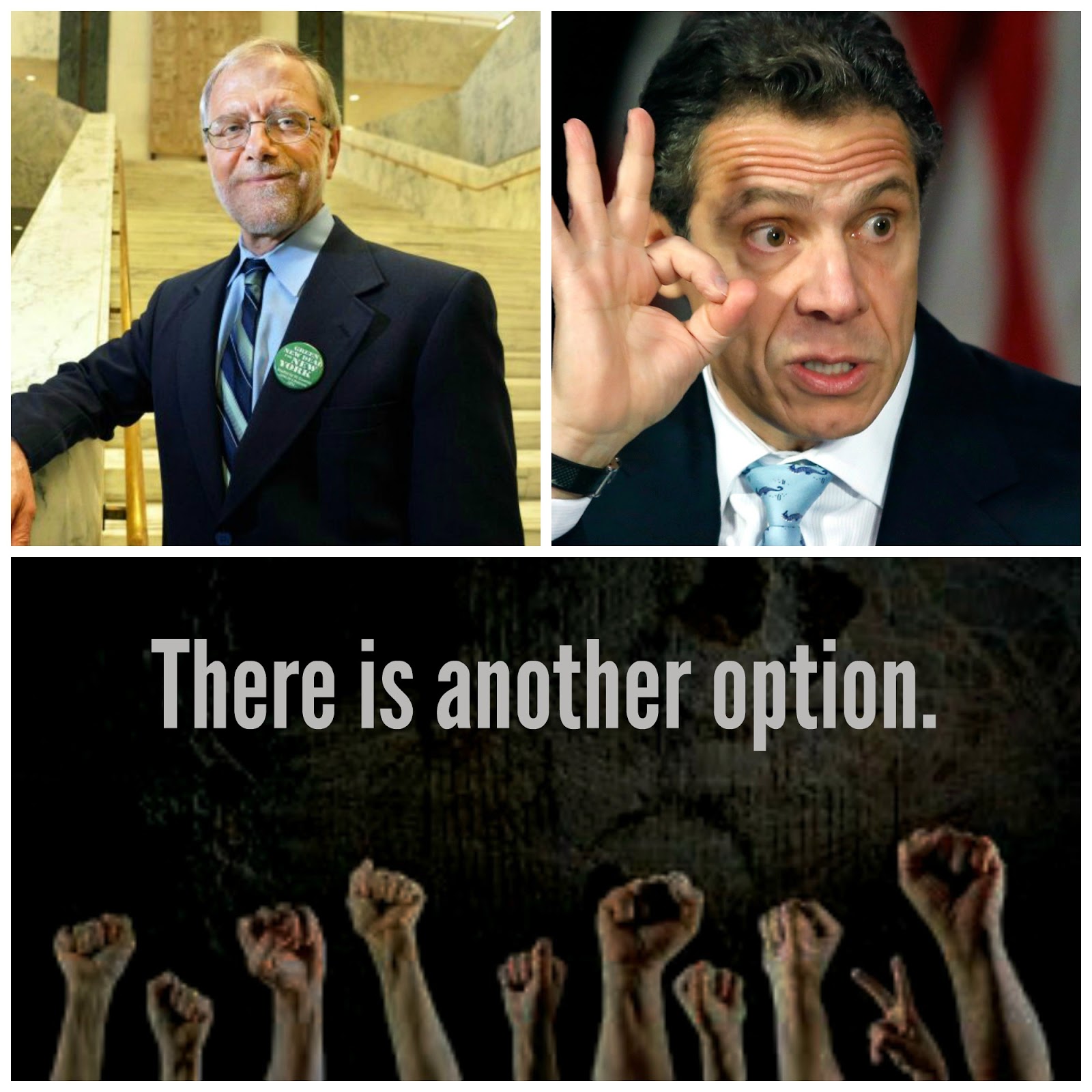
Vote for Howie Hawkins

That's right, I said it.  In this post I wrote the other day, I mentioned that I wasn't sure if I was going to vote for Howie or not.  I agree with almost everything he stands for, but I wasn't sure if I wanted to throw my support behind the green party.  Well, this election, I do.  They're the only party that is truly listening to the stories of working people.  

Howie supports a $15 minimum wage.  That is monumental, and it is essential.  I make $8.50 at my job right now, and I bring home a little over $600 a month.  I'm on the verge of homelessness and every night I pray that my car hasn't been repossessed and will still be outside the next morning.  I lost my full time job a few months ago, I've had health problems that required surgery, and surviving is nearly impossible.  You know what a small, incremental change means when we talk about minimum wage?  It means not enough.  

The minimum wage went up to $8.00 last year and I'm still struggling.  If it went up to $15, I'd be able to pay my bills again.  I wouldn't get ten calls from debt collectors every day.  I'd be able to put $20 from each paycheck into a savings account.  

That's what Howie Hawkins supports.  

Another thing?  His education policies are by far the best of all three candidates.  He wants quality, free education for everyone k-12 an higher ed.  He wants parents and teachers to shape children's learning by opting out of corporate-backed common core and high stakes testing.  Howie supports free tuition at public colleges and universities.  I have $40,000 in debt from school, and no one should have that burden.  

If you take a look at his platform,  you'll see that his policies are reflections of what the public needs.  Better schools, living wages, clean water, affordable housing, better public transportation.  

It comes down to this: Howie's agenda is one of radical change. 

The WFP and its allies are telling us to vote for Cuomo on the WFP line to maintain the party's power.  "If Cuomo receives WFP votes, he'll know the people really want change."  (I'll repeat what I said in that other post: the only message Andrew Cuomo will receive if he gets a ton of WFP votes is that his strategy of bullying and manipulation works.)  The argument is that this will give the party leverage to work with Cuomo and pressure him into making positive changes in NY.  

I'll tell you what.  I do not need the possibility of small, incremental change that comes with a solid showing of WFP Cuomo votes.  I need radical change, and I need it yesterday.  

If you feel like you are willing to gamble on this, then maybe you should vote Cuomo (but probably not).  But if you know that NY needs a better living wage, a better education system, and better tax policies, then you should absolutely vote for Howie Hawkins.  His platform is the only platform that will help us all, and quite frankly he is the only trustworthy candidate.  If you are sick of the old strategy of "voting for the lesser of two evils," dump the republican and the democrat, and vote for Howie Hawkins.  You'll be glad you did.  


__
Charlotte


Saturday, October 25, 2014

The Pragmatism and Privilege Arguments - NY Election 2014

*I do want to mention that the author of the letter I reference here, and so many other people who are encouraging folks to vote for Cuomo on the WFP line, are, to the best of my knowledge, good people, smart people, and people who really want to help everyone and make a better world.  I understand that, despite the fact that I come off as... slightly angry in this post.  

Andrew Cuomo is, quite frankly, a bad person.  He is not just a bad politician.  He's a liar, a player, and overly ambitious.  He's shown us that he cares about himself more than he cares about any random stranger on the street.  

And yet, "progressives" are encouraging us to vote for him.  


Are you kidding?  

They're not.  And I get it.  I get wanting to believe that what the Working Families Party did was good.  It would be wonderful if the democratic party and WFP were good and could be reformed.  But they can't.  No party that sells out working people is a party worth voting for.  

But a lot of people say that voting WFP (for Cuomo) is the best way to send a strong message and to get real results in fights that matter.  (Fights like the one for publicly financed elections, a minimum wage raise, the decriminalization of marijuana and so much more.)  This open letter is a perfect example of the effort people are giving to get Cuomo elected on the WFP line.  

Go read it.  It's pretty bad.  

Real quick summary of most people's arguments:  He's going to win, he might as well get as many WFP votes as possible, because it'll send him a message that we're expecting him to follow through on his promises.  

Talk about defeat.  Let me just make this clear.  The only message Andrew Cuomo will receive if he gets a ton of WFP votes is that his strategy of bullying and manipulation works.  We will have told him that he can threaten us into obedience.  

My friends, that is NOT a message I want to send.   

I want to address a few of the problems with that letter. 

1. "Then the unexpected happened. Governor Cuomo caved. At the last minute, he pledged to push through Fair Elections. And that wasn't all. He agreed to a minimum wage increase with indexing. He agreed to pass the full, 10-point women's equality agenda. He agreed to push through the NYS DREAM Act. He agreed to marijuana decriminalization. He even agreed, remarkably, to help flip the state senate and push for a reunification of the IDC and the Dems -- making it easier to advance a progressive legislative agenda in 2015."  

Problem:  This is not unexpected.  A democratic candidate for a democratic state was threatened with a challenger, so he.... agreed to agree to align with his own party?  Wow, how monumental.  He didn't even give a strong statement in support of the positions.  he just said he would support them.  He could have tattooed the platform on his body and it still wouldn't be enough because agreeing to your own party's ideals is the fucking baseline for running on that line.  Cuomo did the bare minimum, let's throw him a spot on our line.  

2. "There were those of us (like myself) who didn't think his promises were enough. Who argued passionately for Zephyr. Who were heartbroken and bitterly resentful when the WFP state committee voted -- in an admittedly transparent and beautifully democratic process -- to endorse Cuomo. It was, I believed at the time, a violation of our principles and everything we stood for as a party and as a movement."

Problem:  The process underwent when the WFP decided to run Cuomo was the exact opposite of transparent and beautifully democratic.  The vast majority of WFP voters wanted the party to run its own candidate.  But it caved to threats from the governor and from unions (obviously not the rank and file members).  I mean I guess that's beautifully democratic in a sense that that's how democracy works in America.  But then, America doesn't have true democracy. 

3. "Despite feeling somewhat vindicated by Zephyr's performance in the primary, I gradually came to understand that my position was a position of privilege. You see, I am blessed not to have to work for minimum wage. I don't have to struggle to make ends meet, to put food on the table. I don't have to worry about whether or not I will be able to afford college. If I am caught smoking marijuana, the color of my skin means I won't spend very much (if any) time behind bars. And so I began to realize that the endorsement I so resented wasn't at all the "selling out" of the party we helped to build. It was, instead, an emotionally challenging decision reached after many hours of difficult deliberation by a bunch of kind, caring, strategic individuals attempting to use their little bit of influence over the governor to make life better, in tangible ways, for millions of struggling New Yorkers." 

Problem: I've heard the privilege argument from so many people.  They say that real New Yorkers need change now, and being idealistic and hoping for something that can't happen and protesting doesn't get us anywhere near real change.  If Cuomo will agree to support (so, at best, not go against) a fight for a $10 minimum wage, that's where we need to throw our support.  Because it's not fair to ask for more when they're not the ones whose lives are at stake.  

Well, my livelihood is at stake.  I don't always know where my next meal is coming from.  I lost my job a few months ago, and my life has become a constant struggle.  When I got food stamps a couple of months ago, I nearly cried from relief.  So fuck the argument that it's a privileged position to want more for NY.  I honestly need to know if anyone bothered to ask low income people how they felt before making this claim.  It is infuriating when people making a living wage do this act (wth good intentions, to be fair) to actually hinder real change.  

I make about $600 a month.  These bullshit political strategies to maintain power and maybe - maybe - get tiny changes or to get words of support from a governor who loves rhetoric but not action is not helping me.  Want to know a privileged position?  One that says dump your ideals and real problems and do what will keep the WFP alive.  This argument feels to me more like "stand up for the poor people, they need us!" than "listen to and then stand up with the poor people, we all need each other!"  And that is a very dangerous thing.  

I think, if people truly examined their own privilege (me included, because I may be living in poverty, but, like the author of the letter, I'm not black.  I'm not LGBTQ.  I have privilege too.), they'd see that the single best way to change this state is to vote your conscience (which may mean not voting at all this time around) and more importantly, standing up, arms linked together, and demanding more.  If we want to be realistic, this election isn't going to change things.  Mass demonstrations are.  Strikes are.  People doing things together, not strategized BS elections, are the real change makers.

4. "You can throw your vote away on a protest vote for Howie Hawkins and the Green Party. Or, you can vote on the Working Families Party ballot line to hold Governor Cuomo accountable to his promises to raise wages, pass Fair Elections, and make New York State work for all of us."

Problem:  I can't believe I have to even say this, but there is no such thing as "throwing your vote away."  How incredibly cynical and undemocratic.  

And a protest vote?  Howie Hawkins' platform is almost identical to my own.  He is the bravest and boldest candidate in this election.  A Cuomo win will not produce tangible results (not good ones.  I'm sure there will be tangible results as in more kids starving and things like that.), but a Hawkins win certainly would.  

5. "As much as we all hate to hold our noses when we vote, and as tempting as it might be to vote green, this is a time when we need to be pragmatic more than idealistic." 

Problem:  Ah, the argument that is made every single election.  We always choose the less of two evils, and we always get screwed over.  After so many years of that, I need to ask, why in the world do you still believe this lie?  Pragmatism has done nothing for me.  We need to be more idealistic and more creative in our ways of fighting oppression.  The claim that voting for Cuomo will achieve anything good is just absurd. 

Honestly, I'm hoping that very few people vote on the WFP line.  I'd like to see it go away, as it's nothing more than a puppet for the democratic party.  This election, I'll either be voting for Hawkins or for no one.  

If you want change, and you want things like a living wage, then you'll mix pragmatism and idealism and realize that voting for Cuomo isn't an acceptable thing to do and that voting for the lesser of two evils is not our only option.  We can put our bodies on the line, invoke the spirit of revolutionaries before us, and get back to the grassroots.  It is the only thing that has truly brought about positive change in this country.   


_
Charlotte