Showing posts with label good books for kids. Show all posts

Friday, February 17, 2017

The Harry Potter Books Ranked, 2017


Sorry it's been a little while since I've posted.. between then and now I needed an emergency surgery and have just been recovering. There are a lot of things I'd like to post about, but I'm easing myself back in with something light and fun - a ranking of the Harry Potter books. (Not counting The Cursed Child because I'll never consider that an actual part of the story.)

My friend Liz finally read the entire series as my 2016 reading challenge for her and so we've discussed the books quite a bit over the last few months. She is officially a Harry Potter nerd. Thank God. Well, with that and the plethora of HP-related articles floating around the internet, it was sort of inevitable to talk about which books are our favorites. I don't have kids but I imagine it's a bit like picking your favorite child. It's so hard, you love them all.


For me, it seems like I'm always ranking them in a slightly different order. Some are always in the top 3, but there's not a solid list - so I thought it'd be fun to rank them every year or so to see how my preferences have changed (especially since I tend to read each book at least twice a year).

"But how to rank you?"
And so, without further ado, let the sorting er, ranking begin!

7. Harry Potter and the Prisoner of Azkaban 


I hate to do this because it automatically feels like the books at the bottom are books I don't like and that's just not true - each and every one of the HP books are at the top of my all-time favorite lists, after only Jane Eyre. 

To be fair, I've read PoA less than I've read any of the other books in the series. I've actually been thinking I need to read this one as soon as I finish my current book (The Tenant of Wildfell Hall by Anne Bronte). Maybe that will be enough to bring it up a place or two or five in 2018's ranking? 

I do remember really enjoying reading how Harry spent his time in Diagon Alley at the end of summer holidays. And of course, I absolutely love Professor Lupin. And how Harry overcomes the dementors! So beautiful and significant to the whole series. Although... I also remember really hating the end of this book. I know Peter Pettigrew had to escape for the plot to go on, but... ah, I resent the end every. single. time. Had Sirius been a truly free man, he and Harry could have had such a different story! Dammit, Wormtail! DAMMIT, ROWLING!

6. Harry Potter and the Chamber of Secrets
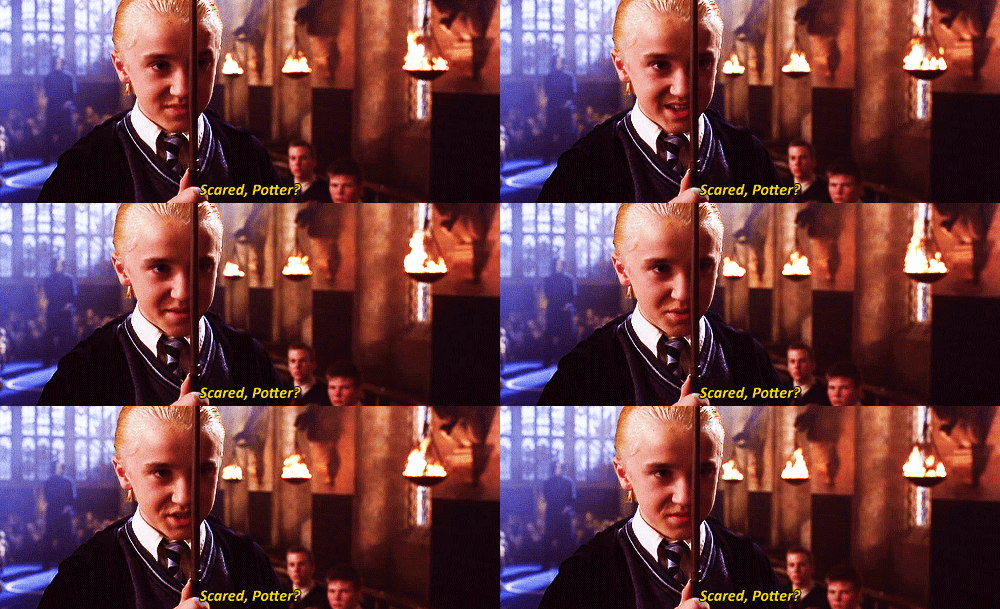

This is another one I haven't read as often as I have books 1 and 4-7, so it's not completely fair. Of course, I still love CoS, just not as much as some of the others. Something I do love about it is the time we get to spend at the Burrow. The Weasleys are the best literary family, hands down. I will say that I think the first two movies (Sorcerer's Stone and Chamber of Secrets) are the best in the franchise. 

5. Harry Potter and the Half Blood Prince

  
I like love stories, but I don't like love triangles. I also don't think Hermione and Ron make a good match. Between those two things, Half Blood Prince loses a little bit of its ~shine~ to me. (I also get generally annoyed because it's the one on tv most often and, like..... show the other movies, would ya?)

I do, of course, love the scenes between Harry and Dumbledore. Learning about Voldemort's past, seeing Harry and Dumbledore's relationship up close... love it. (I love the conversations between the two of them at the end of every book, so HBP is a treat.)

4. Harry Potter and the Sorcerer's Stone


This story might not be as dense as the others, but it's the first one and it gets me every time. There's nothing better than rereading Harry's first time visiting Diagon Alley. The first is wonderful because we get to experience all the magic again.

3. Harry Potter and the Order of the Phoenix 


I know a lot of people think OotP is the "worst" of the Harry Potter books. I disagree.

Harry is definitely annoying in this book. No question about that. And he makes some dumb choices. But the book also includes glimpses into the way our favorite witches and wizards are organizing to resist Voldemort and his influence at the Ministry of Magic (sound real-life familiar, or...?) and that is awesome.

I read a book called How Harry Cast His Spell by John Granger and in it Granger observes that, of many of the people he's talked to about the books, introverts prefer PoA and OotP and enjoy the two better than most extroverts do. I tend to lean more introvert, so maybe that also affects my view of the book, who knows?

2. Harry Potter and the Deathly Hallows

I have read this book so many times that my copy is currently in two pieces, ripped down the spine. I probably should get on it and buy a new one...

This is what the book looked like a year ago when it was still managing to hang on by a single thread... wah
I love damn near everything about this book (don't even talk to me about the movies though... smh). So many of our questions are answered, everything makes sense, the whole story is tied together... I feel like you can't not like it, just for those reasons alone??

The mystery of the horcruxes is also intriguing, as of course is the question of whether or not the Hallows are real (and whether Voldemort knows about them). I like seeing the trio (especially Hermione and Harry) really come into their own, I like the warm, homey feeling we get during the birthday dinner for Harry at the Burrow. There's so much I like. (Though, like everyone else, the deaths are heavy in this one.)

My favorite part of this book is the end, of course. The symbolism, the ending Rowling feared readers would have guessed too early had she explicitly told us it was a Christian story. The best chapter there ever was: The Forest Again. Harry seeing his parents, Sirius, and Lupin - them giving him strength to sacrifice himself so that others may live.

There's not much more you can ask for from a book.

Neville cutting off the snake's head was cool, too.

And finally...

1. Harry Potter and the Goblet of Fire


This is usually the book I proclaim as my favorite of the series. It is perfection.

Sure, it's hard having to endure Ron and Harry's silent fight. But it's worth it because this book is meaty and magical and I don't know, think of another "m" adjective, would you?

I love that we're given some light fun - the Quidditch World Cup (pre-death-eater-parading-around-helpless-muggles, of course), the dance, the Burrow!!, the feasts, the boys getting caught up by the veela, on and on and on. It's got that same magical feeling we were given by the truckloads in Sorcerer's Stone, but the story is also intensifying. We're starting to see real struggle, character development, and obviously, more in-your-face good vs. evil.

Of course, the ending of this one is hard. I think I cry more at the end of this than any of the others, maybe. The moment that comes to mind is when Harry is in the hospital wing after he's returned with the cup and Cedric's body, and Mrs. Weasley (a hero, for real) tells him Cedric's death wasn't his fault. Harry then responds with something like, "I told him to take the cup with me," his eyes filling with tears. (And maybe mine too as I recall this...) And then she hugs him and, not for the first time in the series, he feels glad for it. It's so emotional. GoF, while the graveyard scene is terrifying and horribly sad, is a heck of a book. I love it because it's got fun and danger, it's really the pivotal moment in the series, it's dark but balanced with enough light. It never, ever gets old.

I think it'll still probably be my #1 next year, but I suppose only time will tell.

What do ya'll think?

Sunday, August 7, 2016

Book Review | The Underland Chronicles (Book 5)


A couple of weeks ago I wrote up a little review of how I felt about the fourth book in The Underland Chronicles - Gregor and the Marks of Secret. I loved it and thought it was a good continuation of the series, if a little slower paced than the other books. I also mentioned not remembering quite as much detail since it's been months since I've read the books... it's obviously the same deal with this book. But I think I can still give a pretty decent idea of what this book is about and whether or not you should read it (you should!). 

Like I've said in each of these reviews, this series is amazing. (For those who like kidlit/have kids and are familiar with it: this series is better than Percy Jackson but not quite as good as Harry Potter.) It tackles discrimination, oppression, war, right vs. wrong, morality, and this time, fate. By now Gregor has fought in Underland several times, trying to do what is right (and to be honest, just trying to figure out what is right). He learns of a prophecy that calls for his death (this story line is sort of getting old? I say this as though it ever stops me from reading anything...) and must decide if he's still willing to fight. I guess I won't give the answer away but it's pretty obvious considering it's a novel... 

But anyway. We once again deal with Solovet and her grimy tactics. She's basically America. She wants to look good and fair and all, and she says she stands for justice and peace, but... she tries to "achieve" justice and peace by, like, violent tactics. So... 

Gregor is not a fan. 

A lot of this story is simply battle. We still have some issues and we're not entirely sure who is bad and who is good. I think the ending is mostly a morally sound one. We do not get to know every detail about what happens once the novel is over (big things like "does peace last?" and small things like "what happens to Luxa and Gregor?"), which annoys me a bit. But I thought we were given some clarity on the war and on morals and I think the "right" things happened. (I'm trying and failing to describe this without giving anything away.) Essentially, none of the bad guys truly win. The morally bad characters - whether obnoxiously, Donald Trump-esque bad like Bane or more subtly, Hillary Clinton-esque bad like Solovet are ultimately seen for what they are. It is a dark, hard ending. There are major losses. I cried and I imagine it'd be difficult for kids, but that's true of this story in general once we hit the third book. I'd want to read it with a kid instead of them reading it alone. 

So this whole time we have one species fighting another species, some species driving other species out of their homes, species trying to kill off other species, etc. etc. And throughout this whole thing we see some members, particularly of the oppressor groups, employ awful means. There is little regard for life by these characters, and especially for life that doesn't resemble their own. (Sound familiar? Regalia is America, for real.) And at the very end of the series, our young hero Luxa and the scrappy Ripred, a rat leader, do something completely unprecedented and totally moving (to me, anyway) to change the way things are done and I don't think Collins could have given us a better ending. I don't want to spoil it so I can't say much more, but I think Collins just ended it on such a good and appropriate note. 

Overall as a series these books teach readers to question war, to stand up for the oppressed, to wonder about free will, and to choose good. I don't think it gets much better. I really think I might like this series better than The Hunger Games. I 100% recommend it. 


Since Liz and I now have a book review blog (Filthy Casket Book Reviews!), this can be found over there, too.
Reviews for earlier books in The Underland Chronicles:

Gregor the Overlander (Book 1)
Gregor and the Prophecy of Bane (Book 2)
Gregor and the Curse of the Warmbloods (Book 3)  

Sunday, July 24, 2016

Book Review | The Underland Chronicles (Book 4)


Whoa. It has been nine months since I posted the review of the third book in this series. Nine months! I could have gestated a child in the time it took me to get my act together enough to post this review. A HUMAN CHILD. That's how long I've procrastinated. 

And unlike a child, which would have grown stronger and more defined over time, the nine month break means my memory of the book is fainter, the impression it left lighter. Which makes for a lackluster review. Lackluster, my middle name.

Despite all that, my overwhelming feeling toward this book is that it was fantastic. I don't remember as many details as I did two minutes after reading it, obviously (and my computer did me a solid and deleted my general review of the whole series). But I remember the plot well enough (and was smart enough to dog-ear pages with quotes that struck me) and I definitely remember the themes Suzanne Collins explores and I know that I finished this book feeling like I absolutely needed to get my hands on the fifth book. I appreciated Collins even more than I already did after reading this book. I still am awed by her ability to talk about war and politics in ways that are appropriate for kids (and still interesting for adults). Somewhere between reading the third book in this series and the fourth book, it occurred to me that I might like The Underland Chronicles more than I like The Hunger Games.

   
The fourth book, Gregor and the Marks of Secret, is a bit different from its predecessors in that we don't have a direct prophecy or end point this time. The plot is a bit more mysterious and open ended. Basically, Luxa (I gave some character descriptions here), the future queen, is sent a message of distress and she and Gregor go searching for an answer. They find out that the mice of the Underland are once again being driven out of their homes by a more powerful species. (Sound familiar? Collins' stories are political ones.) But when she and Gregor explore, they realize that (spoiler alert - though this isn't a huge reveal and won't ruin the series for anyone, probably...) this time, the mice aren't just being driven out of their homes; they're being murdered. It's a genocide orchestrated by the Bane and the rats. We see some more character development in this one, especially with Luxa as she begins to truly come into her role. Ultimately, she declares war on the rats.

Needless to say, this book is dark. It's the darkest in the series, in my opinion. If I had kids, I'd want to read it with/to them. I wouldn't want them to read it alone. That said, I still think it's an age-appropriate exploration of war and politics and hatred and fear.

And if you happen to be reading it now, be prepared for some scary real-life parallels:

"He will find followers, because he’s the Bane. He’s got the white coat, and the size, and enough hatred brewing inside him to wipe out the Underland as we know it. Most rats will overlook the fact that he’s unbalanced, because he’ll be telling them exactly what they want to hear. They’ve been starved too long, and then so many died from the plague... especially the pups. No, the gnawers won’t care who he is or what he does if he brings them revenge."

Familiar, right?

While it's a not as conclusive as the previous books, it's still pretty excellent. It's sad, of course. But we get to watch as our characters consider whether there are things worth going to war over, if there are things that justify killing. (And as the series goes on, I tend to think that most of the "good" characters make the right decisions, which is why I think this series is so good for kids. Like it or not, we're currently living in a war-obsessed country and I think it's great for kids to question such values. This book will prompt those questions.) It's also nice to see the characters face trials bravely. Obviously courage and bravery and sacrifice are good things in books and in real life.

Neville knows. He would like The Underland Chronicles.
So basically, loved this book. I didn't love it as much as the third book, but it's an important step in the series and sets us up for the fifth and final book. It doesn't work as a stand alone novel, though, so you'll have to start from the beginning. A very good place to start.

You won't regret it. Go pick up this book/series, pronto.
__


Since Liz and I now have a book review blog (Filthy Casket Book Reviews!), this can be found over there, too. 

Thursday, October 22, 2015

Book Review | The Underland Chronicles (Book 3)

Since Liz and I started a blog devoted to book reviews after I started reviewing this series, I'm going to post this over there, too. Check the page out! 


This is a review of the third book of the series. You can read the review for the first book here and the second one here

In the third book, Gregor is called to the Underland once again, this time to help find a cure for a plague that is spreading and killing the world's mammals. Our familiar main characters set out on this journey - the cure is said to exist, but only in the cradle where it was created - and we're introduced to new characters as well. There's death and destruction. But this book might be my favorite in the series, because it does a great job asking moral questions and it emerges as a sort of allegory of American military policy. (Granted, I'm not sure if Collins meant to mirror America, but I'd be surprised to learn she didn't.)

Basic review: It's a riveting tale, it's well written, and Collins, as always, plays with excellent themes and moral questions. I'd recommend it to a friend. I have recommended it to a friend. That friend is Liz and she still hasn't read Harry Potter but I'm convinced there is still hope for her.  

*Major spoilers ahead.*

Alright, so. Bats, humans, and rats are catching the plague. Beyond the obvious problem - sick people - it threatens to literally eradicate all mammals in the Underland. Of course, there's a prophecy that warns of the plague but suggests there is a chance of hope. Gregor, the prophesied warrior, must travel with several companions to the place where the plague was made.

I haven't gone into much detail about the characters, but let me attempt to give a rough idea real quick of the characters that are important in this review:

Gregor (often referred to as "Overlander"): a boy from NYC, falls into the Underland after his baby sister, Boots (they miraculously both survive, and it's determined that he is the warrior mentioned in several prophecies), Christ-figure, struggles with questions of when/if to fight

Luxa: the future queen of Regalia (the main human city in the Underland), her parents were killed by rats, her cousin died after he betrayed her and all of Regalia by secretly working with rats, granddaughter of Vikus and Solovet (who are powerful members of the council), extremely stubborn, highly trained fighter

Ripred: an old-ish and extremely tough rat, never loses fights, scruffy, harsh, sarcastic, has some followers, is attempting to lead the rats to a new way, wants humans and rats to achieve peace

Hamnet: son of Solovet and Vikus, unknown by younger characters until third book, left Regalia because his mother wanted him to fight and to commit violent atrocities against other creatures

Vikus: an old and wise council member of Regalia, very powerful, grandfather to Luxa, husband to Solovet, wants peace among all Underland creatures if possible, believes violence and war should be last resort, doesn't generally adhere to an "end justifies the means" philosophy, caring

Solovet: harsh, believes the end justifies the means, severe, mother to Hamnet, grandmother to Luxa, not very loving, values humans above other Underland creatures

Phew. There are other important characters in the book, but these are the ones that are important to major plot points.

Also essential to know: all of the Underland creatures are intelligent and sentient. In our real world, of course we value humans above rats. In the Underland, rats are 5+ feet tall, they think, they feel, they are capable of love and of all things humans are capable of (except things that require thumbs. Rats don't have thumbs..). This is also true of bats, cockroaches, spiders, mice, etc. They are human-like in their abilities and their capacities to think and feel.

So like I said, Gregor and some of the characters set out to find the cure, which comes in the form of a plant that only grows in one place. They find it and begin collecting it when a bunch of ants come and destroy every last bit of it. But it's okay, because............

The plague was actually created in Regalia.


Solovet The Vicious assigned a scientist to create a "plague" that she planned to use as biological warfare against the other creatures of the Underland. The plan went awry, obviously, but they still tried to keep it a secret. They already had the cure, they just couldn't tell anyone about it, because then everyone would know that humans were responsible for all of the destruction.

Of course, this caused huge problems. Distrust of humans became stronger, and even humans themselves were embarrassed. Naturally, the scientist was punished, but Solovet, if I remember correctly, just had to stay in her nice home. (Such is always the case, even in the real world. The rich and powerful face no consequences.) She was put on trial, but nothing happened.

This was the first really meaty book in the series. They're all short - nothing on LOTR or HP, but this dealt with complicated issues that we see in the real world. Things like:

preemptive tactics
biological warfare
rules of war
ethnocentrism
exceptionalism
and more

This book called to mind some of the things we learned about in history class as kids. It also made me think of some things our own country still does. Insisting an entire race or region is guilty of something or lesser than you? Attacking innocent people so that they can never even think of becoming threats? Familiar themes, sadly.

It's these things that lead me to believe my friends would enjoy the series. Also, it's what makes me think it's a great series for kids. When I have kids, I want them to think about these things. I want them to question what they've been told about military might and exceptionalism. It's one thing to be proud of who you are, it's another to think everyone else is lesser than you and unworthy of life. This book, and this series, talks about those things in an age-appropriate way for kids. And for adults, it's an engrossing but easy-to-read book to fly through. Win-win.

Stay tuned for the next review in this series!
__
Charlotte

Saturday, September 26, 2015

Book Review: The Underland Chronicles (Book 1)


There are five books in this series - I wrote up an entire review of all of it, but this is a blog, not a massive Wikipedia page, so methinks it best to break the reviews up into books.

Book 1: Gregor the Overlander 
Book 2: Gregor and the Prophecy of Bane
Book 3: Gregor and the Curse of the Warmbloods
Book 4: Gregor and the Marks of Secret
Book 5: Gregor and the Code of Claw

First, a quick intro to the whole series:

Alright, so.  These are children’s/YA books, making them very easy reads for most adults.  It only took me a few hours to finish each of them.  I imagine they wouldn’t be hard for kids who are proficient readers, either.  The reason I only gave the books 4/5 stars is just the writing itself.  It’s good, but it’s simple.  I know some people love this!  My own preference, though, is that it’s a little challenging.  Of course, it’s a children’s book, so I’m not holding this to my own standards of difficulty – but it would have been easy-peasy for my 11 year old sister.  My go-to comparison series is Harry Potter (of course!), and I think even Sorcerer’s Stone and Chamber of Secrets would challenge my little sister a bit more than these did. 

That said, the books were amazing.  The stories are the exact kind of stories I want my siblings to read and that I’d want my own kids to read one day.  They’re about war, morality, oppression, and justice.  (I guess I should also include that while my own favorite part of the books were the themes, I imagine any kids reading this book would love the respect the author gives to children and their feelings/emotions/challenges/abilities.  I expect it’d make them feel a bit empowered.)

The author is Suzanne Collins of Hunger Games fame.  It’s the reason I bought the first book (Gregor the Overlander) to begin with.  I loved the themes Collins explored in the HG trilogy and I wanted more.  The books did not disappoint.

Gregor the Overlander:
(There are no major spoilers in this review.)

Like I said, I picked this book up because I saw “Suzanne Collins.”  I didn’t flip to a random page and read, I just… bought it.  So when I went home and started reading about a world with giant cockroaches, rats, and bats, I may or may not have rolled my eyes and thought I had wasted $7.  I felt certain it was going to be really stupid. 

Well butter my buns and call me a biscuit; I was pleasantly surprised.  I couldn’t put the book down.  While the themes weren’t quite as developed in this book as they were in the following books (fair enough – it really is an introduction), it’s an action-packed adventure.  We get a good idea of some of the characters, and it does a great job of laying the foundation for the rest of the series while still telling an exciting story itself, which is an admirable feat for any first book in a series. 

The climax of the story establishes Gregor, the boy from NYC who falls into the Underland, as a Christ-like figure, something all the best fantasy stories have (Aragorn, Frodo, and Gandalf in LOTR, Harry in HP, etc.).  It was my favorite part of the book and it was an important beginning to the development of Gregor’s character throughout the stories.  My favorite kind of character in fantasy is the one who struggles and is tempted by evil, but who is virtuous.  A lot of the other characters are wonderful, too.

Alternative title: white men with blue eyes. more diversity, please, authors/movie makers*
The next few reviews will be more detailed since the stories are more complex and we learn more about the characters, but I'll say that the first book has stories of sacrifice, tolerance, peace above war, and justice.  

Overall, it was great.  Collins managed to write an exciting and interesting novel while setting the stage for a great series.  Of the five books, it probably was my least favorite, but only because I thoroughly enjoyed the moral questions posed in the next four books, and we don’t get as much of that in the first book.  I’d recommend it to anyone, but especially to my adult friends who question war, oppose ideas of ethnocentrism, and love fantasy.  (In fact, I’ve already badgered a couple of my friends and repeatedly insisted that they must read it, now.)  As for kids – I think most kids will like this, but especially kids who are into riddles, adventure, and folktales.  I’m planning on getting a copy of this for my siblings for Christmas. 

Go read this book!

*As far as I remember, Collins didn't give a ton of physical description for Gregor or his family.  Here's hoping that maybe, if they ever make a movie, they cast poc.  It's important
__
Charlotte

pssst: Check out my Goodreads profile here.  (It's still a slacker prof, I'm working on it.)